After years of rumors, leaks, concepts, and speculation, Apple has finally done it: iPhone Duo is official.
Apple’s first foldable iPhone represents one of the biggest changes to the familiar smartphone design in the history of the product. Instead of simply making another iPhone faster or improving its cameras, Apple has fundamentally changed the way the device can be used.
Closed, iPhone Duo behaves like a compact smartphone. Open it, and the device transforms into something much closer to a small tablet, offering significantly more room for apps, videos, games, multitasking, productivity, and Apple Intelligence.
And while its $1,999 starting price makes it clear that this is very much a premium device, iPhone Duo feels like more than another expensive addition to Apple’s lineup.
It may offer an early look at where Apple believes smartphones could be heading next.
What Is iPhone Duo?
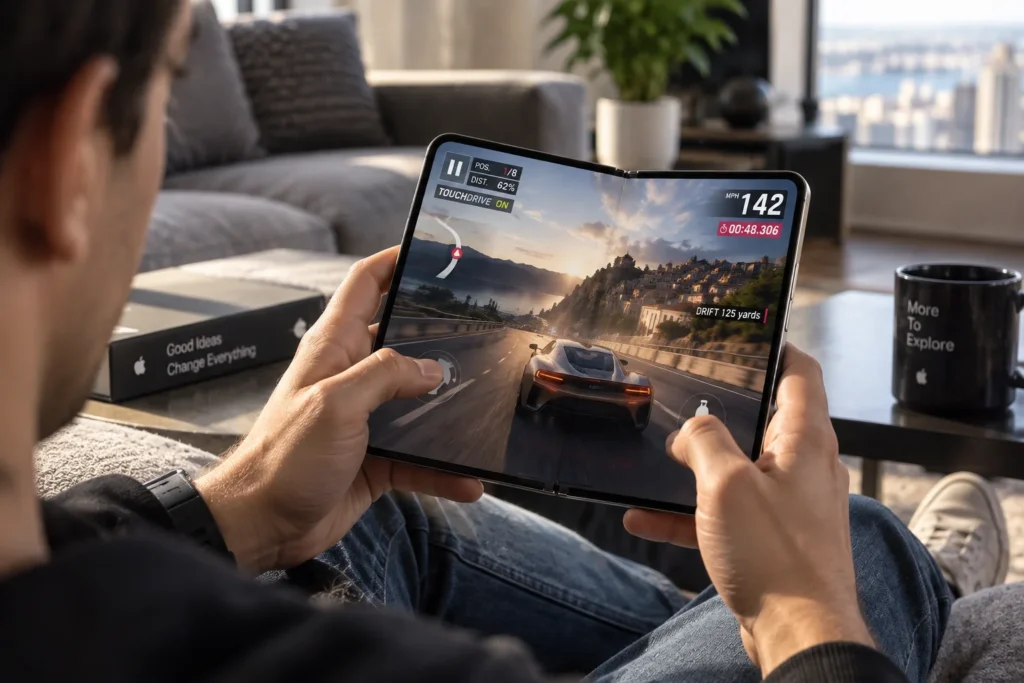
iPhone Duo is Apple’s first foldable iPhone, combining an external 5.4-inch Super Retina XDR display with a much larger 7.6-inch foldable Super Retina XDR screen on the inside.
When the phone is closed, the external display provides around 90 percent of the screen area offered by iPhone 18 Pro. When opened, the internal display is around 50 percent larger than the display on iPhone 18 Pro Max.
That difference is important.
The idea is not simply to give users a larger screen. Instead, Apple wants the device to adapt depending on what someone is doing.
Need to quickly answer a message, check Maps, or take a photo? Keep it closed.
Want to edit something, watch a movie, browse the web, play a game, or work with two applications simultaneously? Open it.
Apple has also designed both screens with matching proportions, helping content transition naturally between the outer and inner displays.
A 7.6-Inch Foldable Display Changes the iPhone Experience
The main attraction is undoubtedly the 7.6-inch internal display.
It is the largest display Apple has ever placed on an iPhone, and it immediately opens possibilities that simply aren’t practical on a traditional smartphone.
Multitasking is one of the most obvious examples.
With iPhone Duo unfolded, users can run two apps side by side using Split View. You could have Safari open on one half of the display while writing a message on the other, compare two websites, follow a video call while checking documents, or interact with Siri while continuing to view another app.
You can even open two windows of the same app.
Safari, for example, could display two different websites simultaneously — something that could be particularly useful when researching products, comparing information, or working on the move.
The internal screen also supports ProMotion, Always-On functionality, and up to 3,000 nits of peak outdoor brightness.
Apple has added a nano-textured surface designed to reduce reflections while also making the display crease less noticeable.
That last point could be particularly important.
The visible crease has traditionally been one of the biggest aesthetic compromises of foldable smartphones, so Apple’s approach will be interesting to evaluate once the device reaches consumers.
iOS 27 Has Been Redesigned for iPhone Duo
Hardware alone would not be enough to make a foldable iPhone useful.
Apple has therefore adapted iOS 27 specifically around the new form factor.
When iPhone Duo is unfolded, two Home Screen pages can appear simultaneously. Interface elements such as navigation controls and system information have also been repositioned to make better use of the larger display.
The Dynamic Island has been redesigned for the unusual screen format, while applications can react dynamically as the phone is opened, closed, rotated, or flipped.
Apple’s own apps have already been optimized for the new design, while third-party developers can take advantage of updated APIs.
Apps including Netflix, Zoom, and Slack are among those already taking advantage of the foldable interface.
The result should make iPhone Duo feel less like an oversized iPhone and more like a device whose software was intentionally designed around having two different screen configurations.
Apple’s Hinge Is a Crucial Part of the Design
A foldable smartphone introduces one obvious concern: durability.
Unlike a traditional iPhone, a foldable model depends on moving components and a flexible internal screen that may be opened and closed thousands of times throughout its life.
Apple says the iPhone Duo hinge contains more than 100 components engineered to control the folding mechanism and support the display when the device is fully opened.
The chassis uses Grade 5 titanium, while Ceramic Shield protects the rear and Ceramic Shield 2 is used on the outer display.
The folding screen itself uses several reinforced layers. High-strength glass sits around the flexible display panel, while specialized adhesives allow the materials to move as the device folds. A titanium plate underneath provides additional structural support.
The internal display also features a scratch-resistant coating and a custom polymer cover layer.
iPhone Duo carries an IP68 rating for water and dust resistance as well.
Those specifications sound promising, but long-term real-world durability will be one of the most interesting aspects to watch once thousands of people begin using the phone every day.
Foldable smartphones are mechanically more complicated than conventional phones, and durability remains an important consideration for anyone thinking about spending nearly $2,000.
A20 Pro Brings Serious Performance
At the heart of iPhone Duo is Apple’s new A20 Pro chip, the same processor generation used in the iPhone 18 Pro lineup.
Apple says the chip is manufactured using a 2-nanometer process and features a six-core CPU, seven-core GPU, and a Dual 16-core Neural Engine.
The Neural Engine is especially relevant as Apple continues expanding on-device artificial intelligence.
According to Apple, A20 Pro offers up to 35 percent better sustained performance than iPhone 17 Pro when paired with the thermal system used inside iPhone Duo.
And that brings us to another interesting engineering decision.
Apple has included a custom vapor chamber cooling system.
The larger screen encourages activities such as gaming, multitasking, video editing, and AI processing, all of which can put significant pressure on the processor.
Better thermal management should allow the A20 Pro to maintain high performance for longer without excessive heat or aggressive performance throttling.
A Dual-Battery System
The folding design also changes how Apple approaches battery placement.
Instead of using one traditional battery, iPhone Duo contains a battery on each side of the device.
Software manages both batteries together as a single power system.
Apple estimates up to 31 hours of video playback when using the inner display and up to 44 hours when primarily using the smaller outer display. When both screens are used more evenly, Apple estimates up to 24 hours of usage per charge.
Fast charging is supported as well.
Apple says the battery can reach approximately 50 percent in around 20 minutes with compatible wired charging.
Wireless charging through MagSafe or Qi2 can reach 50 percent in roughly 30 minutes under supported conditions.
Battery performance will obviously depend heavily on how people use the device. Running two apps simultaneously on a large OLED display will naturally consume more energy than occasionally checking messages on the outer screen.
Still, the dual-battery architecture demonstrates how extensively Apple has redesigned the internal layout for its first foldable iPhone.
iPhone Duo Introduces New Camera Possibilities
The folding design is not only useful for productivity.
It also changes photography.
The iPhone Duo camera system includes a 48MP Fusion Main camera and a 48MP Fusion Ultra Wide camera.
The main camera can capture full 48MP images, while Apple continues using 24MP as the standard resolution to balance detail and file size. An optical-quality 2x option is also available using the main sensor.
But the most interesting features come from having displays on both sides of the phone.
When taking someone’s picture, for example, the person being photographed can see a live preview of themselves on the external display.
Apple calls this Duo Preview.
That makes it easier for subjects to adjust their position, expression, or framing while the photographer uses the larger display.
Users can also take selfies using the higher-quality rear cameras while viewing themselves on the outer screen.
Another feature called Smart Take uses on-device AI to analyze the scene and automatically capture images when subjects appear ready for the shot.
Kid Cue takes a slightly more playful approach by displaying animations on the external screen to encourage children to look toward the camera.
These may sound like relatively small additions, but they demonstrate how Apple is trying to use the foldable hardware for more than simply increasing screen size.
It Can Even Become Its Own Tripod
The hinge creates another practical advantage.
Because iPhone Duo can remain partially folded, it can support itself on a flat surface.
That means users can position the phone for photos, videos, FaceTime calls, time-lapses, or content creation without necessarily needing a traditional phone stand.
The main camera can record 4K video at up to 120 frames per second in Dolby Vision, while Cinematic effects can be applied after recording at supported frame rates.
For creators who frequently record short videos or social content directly from their phones, having a device that can physically support itself could prove surprisingly convenient.
Apple Intelligence and Siri AI Benefit From the Larger Screen
The larger display may also become especially important for Apple Intelligence and Siri AI.
On iPhone Duo, Siri can remain visible on one side of the screen while another application stays open on the other.
That changes the assistant from something that temporarily takes over the phone into something that can exist alongside whatever the user is doing.
Siri AI can use personal context, onscreen awareness, and information from supported apps to answer questions and perform actions.
Apple Intelligence also continues to offer AI-powered image editing, writing tools, content generation, and other features across compatible applications.
The foldable screen could make these tools considerably more practical.
Instead of constantly switching between an AI assistant and another application, users can potentially interact with both at the same time.
That may end up being one of the most meaningful advantages of the entire design.
Touch ID Makes an Unexpected Return
Interestingly, Apple’s first foldable iPhone also brings back something many users may remember fondly: Touch ID.
Rather than placing it beneath the display, Apple has integrated the fingerprint sensor into the side button.
That makes sense for a foldable device because the button remains accessible whether iPhone Duo is open or closed.
Users can also unlock the phone using a compatible Apple Watch.
The device continues to include Camera Control, while a new Siri Camera mode allows Siri to interpret what the camera sees and provide information or perform supported actions.
iPhone Duo Price and Release Date
Unsurprisingly, Apple’s first foldable iPhone is expensive.
iPhone Duo starts at $1,999 in the United States for the 256GB version.
Storage configurations include:
256GB, 512GB, 1TB, and 2TB.
Two colors will initially be available: Star White and Night Sky.
Apple will open preorders on October 16, 2026, with the first devices becoming available on October 23, 2026 in more than 70 countries and regions.
Additional markets will follow from October 30.
This positioning makes it clear that Apple is treating iPhone Duo as an ultra-premium device rather than an immediate replacement for the standard iPhone lineup.
Is a Foldable iPhone Really Necessary?
This is where things become more subjective.
Most people probably don’t need a foldable smartphone.
A standard iPhone already handles messaging, social media, photography, web browsing, streaming, navigation, gaming, and everyday productivity perfectly well.
But technology is not always about solving problems that are impossible to solve otherwise.
Sometimes it is about making familiar tasks more comfortable.
A larger screen that still fits into a pocket could genuinely be useful for reading, editing documents, multitasking, gaming, watching videos, working remotely, or using AI tools.
For other users, however, those benefits may not justify a $1,999 starting price.
And that’s perfectly reasonable.
iPhone Duo is clearly not designed to become everyone’s next iPhone overnight.
Apple Is Finally Entering the Foldable Era
Perhaps the most interesting thing about iPhone Duo is what it represents for Apple.
For nearly two decades, the basic shape of the iPhone has remained remarkably consistent.
Processors became dramatically faster. Cameras evolved from simple sensors into sophisticated imaging systems. Displays became larger and brighter. Bezels became smaller. Artificial intelligence became increasingly important.
But the fundamental idea remained the same: a rectangular piece of glass that lives in your pocket.
iPhone Duo changes that formula.
It can function as a compact smartphone when closed and transform into a larger workspace when opened.
Whether that eventually becomes the future of the iPhone or remains a premium niche will depend on how consumers respond once the device reaches stores.
Durability, battery life, app optimization, the visibility of the screen crease, and everyday practicality will matter far more than specifications alone.
And then there is the price.
At $1,999, Apple is asking users to make a significant investment in a completely new kind of iPhone experience.
Still, after years of incremental smartphone evolution, it is refreshing to see Apple experimenting with the physical form of the iPhone again.
iPhone Duo may not be the iPhone for everyone — but it could be the beginning of a very different future for Apple’s most important product.