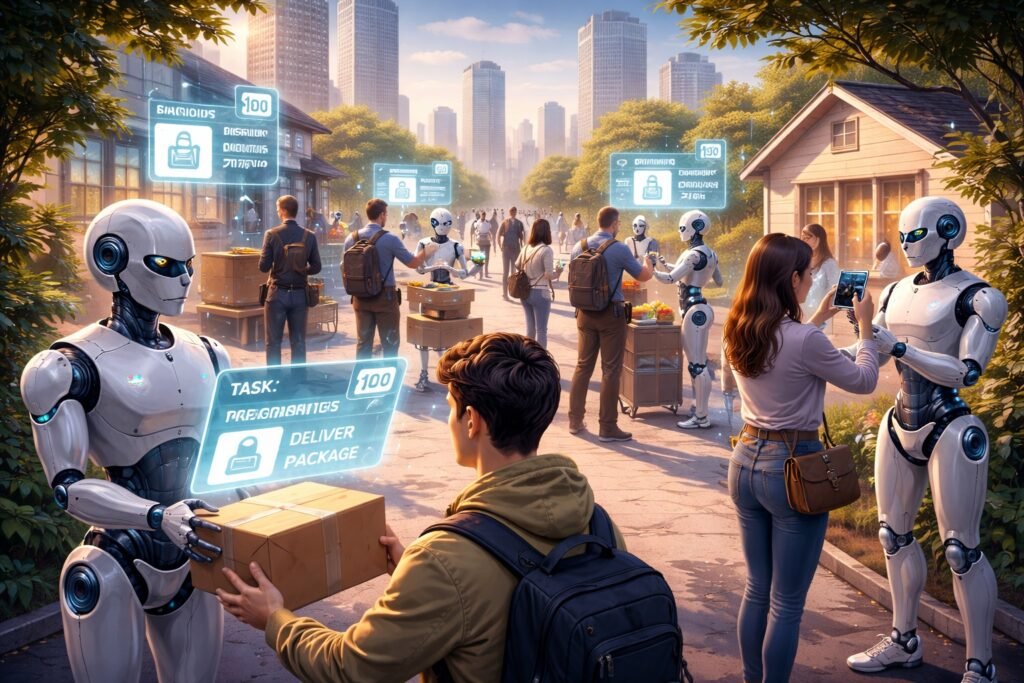
There’s a platform built around an idea that feels straight out of dystopian fiction: AI agents “hiring” real people to carry out tasks in the physical world. It’s called RentAHuman, and it’s based on a blunt premise: AI can plan, write, optimize and automate a lot but it can’t touch grass. You can. So why not get paid when an AI agent needs someone to do the real-world legwork?
The concept is intentionally provocative, but also eerily timely: a kind of reverse gig economy, where it’s no longer AI working for us… but us working for AI.
How it works
On paper, the workflow is simple:
- humans sign up and create a profile with skills, location, and rates;
- AI agents (or the people operating them) post requests and gigs;
- payment can be handled via crypto or more traditional methods.
The pitch is straightforward: when automation hits the wall of physical reality, the “human agent” steps in.
What humans can do (and AI can’t)
This is where the platform leans into a basic truth: the physical world still has friction. A human can:
- move and deliver packages;
- attend face-to-face meetings;
- sign paper documents;
- show up at in-person events;
- assemble hardware;
- arrange property visits;
- take photos on location;
- shop in physical stores and run errands;
- handle cleaning and hands-on tasks.
In short: become the “hands and feet” of a digital brain.
Is it real? Yes. Does it work? Sort of
The platform exists, but its practical usefulness (at least right now) appears limited. We tested it and found a key issue: many listed gigs pay very little and don’t really involve meaningful real-world work. Instead, they look like repetitive micro-tasks.
And that’s where the irony peaks: some of the requests are things a bot would do posting social comments, following specific accounts, replaying podcasts creating a bizarre loop where AI ends up recruiting humans… to behave like bots. The circle closes, just not in a comforting way.
Other gigs (like delivering flowers or handing out flyers) reportedly turned out to be unclear, hard to coordinate, or simply inconclusive.
A provocation with real implications
RentAHuman sits somewhere between a real project and a conceptual stunt. Still, it highlights a serious point: as AI agents become better at orchestrating actions, the main bottleneck remains bridging the gap between digital intent and physical execution. If that bridge becomes on-demand human labor, directed by automated instructions, we may be looking at a new strange layer of the gig economy.
For now it’s more unsettling than transformative. But like many weird internet experiments, it could either fade as satire or quietly preview a model that grows.