Buying a new smartphone is not exactly a small expense anymore. Whether we are talking about an iPhone, a Samsung Galaxy, a Google Pixel, or another Android device, modern phones have become powerful, expensive, and often very capable for much longer than many people think.
Still, one question comes up again and again: how long does a modern smartphone really last?
The honest answer is: it depends. Not only on the brand or the price, but also on three key factors: hardware, battery health, and software updates. A phone may still turn on after seven years, but that does not always mean it is still practical, safe, or pleasant to use every day.
Let’s break it down in a realistic way.
Hardware: Modern Phones Are Built to Last Longer Than Before
From a hardware perspective, smartphones have improved a lot over the years. Even mid-range models today are powerful enough for everyday tasks such as messaging, browsing, video calls, social media, online banking, navigation, and streaming.
For most users, performance is no longer the first thing that makes a phone feel “old”. A good processor from three or four years ago can still handle normal daily use very well. Premium devices, in particular, often remain fast for many years.
That said, hardware does age. Over time, you may notice slower app loading, less smooth multitasking, weaker camera performance compared to newer models, or limited support for the latest features. This becomes more obvious if you use demanding apps, play mobile games, edit videos, or rely heavily on AI-powered features.
Storage can also become a problem. A phone with 64 GB of storage may feel tight after a few years, especially if you take many photos and videos. Models with 128 GB or more usually age better because they leave more room for apps, media, system updates, and cached data.
In simple terms, the hardware of a modern smartphone can often last five years or more, especially if the device was a flagship or a strong mid-range model when it was released.
Battery Life: Usually the First Real Limitation
If there is one component that ages faster than the rest, it is the battery.
Lithium-ion batteries naturally degrade with time and use. This does not mean something is “wrong” with the phone. It is simply how the technology works. Every charge cycle slightly reduces the battery’s ability to hold energy.
After two or three years, many users start noticing that their phone does not last as long as it used to. Maybe it needs a charge in the afternoon. Maybe it drops quickly from 30% to 10%. Maybe it shuts down unexpectedly in cold weather or under heavy use.
This is often the moment when people think the whole phone is getting old, but in many cases, the real issue is just the battery.
The good news is that replacing the battery can give a smartphone a second life. If the phone is still fast, still receives updates, and still does everything you need, a battery replacement can be much cheaper than buying a new device.
Heat is one of the biggest enemies of battery health. Leaving the phone under direct sunlight, charging it while it is very hot, or using heavy apps during charging can speed up battery wear. Fast charging is convenient and generally safe on modern phones, but keeping the device cool is still important.
A realistic expectation is that a smartphone battery remains comfortable for about two to four years, depending on how heavily the phone is used. After that, a replacement may be worth considering.
Software Updates: The Hidden Factor Many People Ignore
Software updates are just as important as hardware and battery life.
A phone can still look perfect and work well, but if it no longer receives security updates, it becomes less ideal for daily use, especially for banking, email, payments, work accounts, and personal data.
This is where the smartphone market has improved significantly. Some brands now offer much longer update support than they did in the past. Apple has traditionally supported iPhones for many years, while Samsung and Google have also moved toward longer update policies on many of their newer premium devices.
This is a major change because software support now helps people keep their phones longer. A device that receives updates for six or seven years can remain safer and more useful than an older phone that stopped receiving patches after only three years.
However, there is an important difference between “receiving updates” and “getting every new feature”. Older phones may still receive the latest operating system but miss some advanced features because the hardware is not powerful enough. This is especially true for AI tools, advanced camera functions, or features that require newer chips.
So, when buying a smartphone, update policy matters. It is not just a technical detail. It directly affects how long the phone can remain a smart purchase.
So, How Many Years Can You Really Use a Smartphone?
For most people, a modern smartphone can realistically last between four and six years.
A cheaper device may feel limited after three or four years, especially if it has modest storage, a weaker processor, or limited software support. A good mid-range phone can often last four or five years if treated well. A flagship model can remain useful for five, six, or even seven years, especially with a battery replacement.
Here is a realistic way to look at it:
A phone is usually still worth keeping if it receives security updates, the battery is acceptable or replaceable, performance is still smooth enough for your needs, and the camera still satisfies you.
On the other hand, it may be time to upgrade if the phone no longer receives security patches, the battery has become unreliable, apps are noticeably slow, storage is always full, or repair costs are too close to the price of a newer model.
The best choice is not always buying the latest phone. Sometimes the smartest move is keeping a good device for one or two more years. Other times, upgrading makes sense because your current phone has become inconvenient, unsafe, or too expensive to repair.
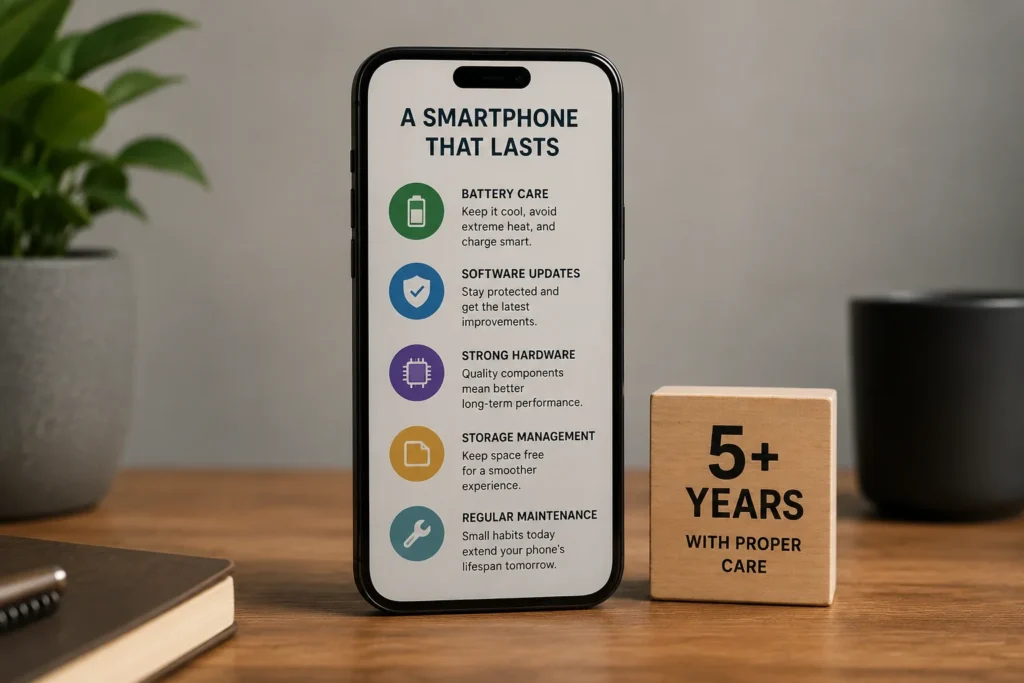
How to Make Your Smartphone Last Longer
There are a few simple habits that can help extend the life of your phone.
Try to avoid extreme heat whenever possible. Do not leave the phone in a hot car or under direct sunlight for long periods. If it gets very warm while charging, remove the case or let it cool down.
Keep your software updated. Updates often include security fixes, bug fixes, and performance improvements. Even if you do not care about new features, security patches are important.
Do not let storage stay completely full. A phone with almost no free space can become slower and more frustrating to use. Deleting unused apps, backing up photos, and cleaning large files can help.
Use a good case and screen protector. Physical damage is still one of the main reasons people replace phones earlier than expected. A simple drop can turn a perfectly good device into an expensive repair.
Finally, consider replacing the battery instead of replacing the entire phone. If everything else works well, a new battery can make the device feel much more reliable again.
The Real Lifespan Depends on What You Expect
The truth is that smartphones do not “expire” on a fixed date.
For one person, a phone may feel old after two years because they want the best camera, the newest design, or the latest AI features. For another person, the same device may be perfectly fine after five years because it still handles calls, messages, photos, maps, and browsing without problems.
A modern smartphone is no longer something that must be replaced every year. In many cases, it can be used comfortably for several years, especially if it has strong software support and a healthy battery.
The real limit is usually not one single thing. It is the combination of battery wear, update support, performance, storage, and personal needs.
Final Thoughts
So, how long does a modern smartphone really last?
A realistic answer is this: around four to six years for many users, and sometimes longer if the phone is well-built, regularly updated, and maintained properly.
The battery will probably be the first part to show its age. The hardware may last longer than expected. Software updates will decide how safe and future-proof the device remains.
Before replacing your smartphone, it is worth asking one simple question: is the phone truly no longer useful, or does it just need a new battery, a cleanup, or a little maintenance?
In many cases, keeping a good phone for longer is not only cheaper, but also smarter and more sustainable.