Artificial intelligence has already changed the way many people work, search for information, write, create content, and solve everyday problems. But now a new concept is becoming more and more important: AI agents.
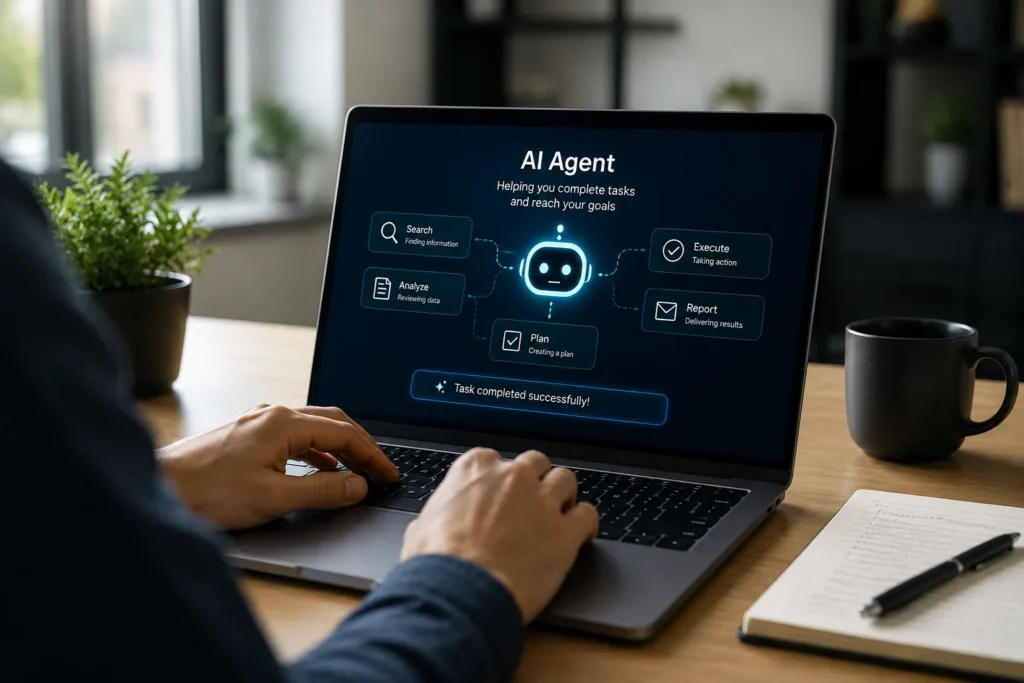
At first, the term may sound technical or even a little futuristic. In reality, the idea is quite simple. An AI agent is not just a chatbot that answers a question. It is a system designed to understand a goal, plan the steps needed to reach it, use tools when necessary, and complete tasks with a certain level of autonomy. IBM describes AI agents as systems that can autonomously perform tasks by designing workflows with the tools available to them.
That difference may seem small, but it is actually very important. A normal AI assistant waits for your instructions. An AI agent can go further: it can take action, follow a process, check information, make decisions within defined limits, and help complete a task from start to finish.
What Are AI Agents?
To understand AI agents, it helps to start with a simple example.
Imagine asking a traditional chatbot: “Can you help me plan a business trip”? The chatbot might suggest hotels, flights, places to eat, and a possible schedule. Useful, of course, but you still have to open websites, compare prices, check availability, book everything, add the trip to your calendar, and maybe send an email to your team.
An AI agent could potentially do much more. It could search for suitable flights, compare options based on your preferences, check your calendar, suggest the best travel window, prepare a draft itinerary, and even complete certain actions if you give it permission.
In other words, an AI agent is designed to move from conversation to execution.
This is where the real shift begins. We are no longer talking only about software that gives answers. We are talking about software that can help perform actions.
AI Agents vs. AI Assistants: What Is the Difference?
The easiest way to explain the difference is this: an AI assistant is usually reactive, while an AI agent is more proactive.
An assistant responds when you ask something. An agent works toward a goal. IBM explains this distinction by describing AI assistants as tools that perform tasks at your request, while AI agents are designed to work autonomously to achieve a specific goal using the resources available to them.
For example, an AI assistant can summarize an email thread. An AI agent could read the email thread, identify the action items, create a task list, draft replies, check deadlines, and remind the right people.
This does not mean AI agents should operate without human control. In fact, the most useful agents will probably be the ones that work with people, not instead of them. The human still defines the objective, approves sensitive actions, checks important results, and makes final decisions where judgment is required.
Why AI Agents Matter
AI agents matter because they could reduce the gap between knowing what to do and actually doing it.
Many digital tools already help us work faster, but they still require a lot of manual effort. We switch between tabs, copy and paste information, compare data, write messages, organize files, schedule meetings, and repeat small tasks every day.
AI agents could help connect these steps.
In a business context, this could mean agents that manage customer support tickets, monitor dashboards, prepare reports, analyze documents, assist sales teams, or help employees find internal knowledge faster. Google, for example, has worked on enterprise AI agent tools designed to help employees find information across an organization, synthesize it, and act on it through agents.
Microsoft has also placed strong emphasis on AI agents in the workplace, describing a future where agents take on more execution and people have more room to direct work, make decisions, and focus on higher-value outcomes.
The promise is clear: less repetitive work, more time for strategy, creativity, problem-solving, and human relationships.
Where AI Agents Could Be Useful
AI agents could be useful in many areas, especially where tasks are repetitive, structured, or spread across different tools.
In customer support, an AI agent could analyze a customer request, search the knowledge base, suggest a solution, update the ticket, and escalate the case to a human operator when needed.
In marketing, an agent could help monitor campaign performance, summarize results, suggest improvements, and prepare content drafts based on brand guidelines.
In administration, agents could organize documents, compare invoices, fill forms, extract key information from files, or prepare internal reports.
In software development, agents could help review code, detect bugs, create documentation, or complete specific development tasks under supervision.
For everyday users, the possibilities are just as interesting. An AI agent could help plan a trip, organize a personal budget, compare products before a purchase, manage reminders, or simplify complex online searches.
The real value is not only speed. It is the ability to reduce friction. When technology handles the boring parts more smoothly, people can focus on the parts that require taste, responsibility, empathy, and judgment.
The Reality: AI Agents Are Powerful, but Not Perfect
It is important not to confuse potential with perfection.
AI agents are exciting, but they are still evolving. They can make mistakes, misunderstand context, rely on incomplete information, or take actions that need correction. This is especially important when they are connected to email, business data, payment systems, customer records, or other sensitive tools.
The business world is still experimenting. McKinsey reported that no more than 10% of respondents had scaled AI agents in any individual business function, showing that many companies are interested in agentic AI but have not yet fully integrated it into daily operations.
That is a useful reminder. AI agents are not a magic button. They require good data, clear rules, strong security, human oversight, and well-designed workflows.
Security and trust are also major concerns. McKinsey has highlighted security and risk concerns as a leading barrier to scaling agentic AI, with inaccuracy and cybersecurity remaining among the most important risks as adoption grows.
This does not mean AI agents should be avoided. It means they should be introduced carefully.
Human Oversight Will Still Matter
One of the biggest misunderstandings about AI agents is the idea that they will simply replace human work. In reality, the most realistic scenario is more nuanced.
AI agents may take over certain tasks, especially repetitive or rule-based ones. But human oversight will remain essential, particularly in areas involving ethics, creativity, negotiation, emotional intelligence, legal responsibility, and strategic decisions.
A good AI agent should not remove people from the process. It should support them.
Think of it like a very capable digital colleague. It can help prepare the work, organize information, suggest actions, and reduce manual effort. But it still needs direction, boundaries, and review.
This is especially true for businesses. Before giving an AI agent access to important systems, companies need to ask practical questions:
What can the agent do?
What should it never do?
Who approves important actions?
How are mistakes detected?
How is sensitive data protected?
These questions are not boring technical details. They are what make the difference between useful automation and risky automation.
Will AI Agents Change Everyday Technology?
Most likely, yes.
Over time, AI agents could become part of many digital products we already use: browsers, office suites, smartphones, ecommerce platforms, customer service systems, and business software.
Instead of opening ten different apps to complete a task, users may increasingly ask an agent to coordinate the process. The agent might not just provide information, but help complete the workflow.
This could make technology feel less fragmented. Today, we often adapt ourselves to software. In the future, software may become better at adapting to our goals.
That said, the transition will not happen overnight. Some agents will be genuinely useful. Others will be overhyped. Some will save time. Others may create extra work if they require constant correction.
The winners will be the AI agents that are reliable, transparent, easy to control, and genuinely helpful in real situations.
The Future of AI Agents
AI agents represent one of the most important directions for artificial intelligence. They show how AI is moving beyond simple conversation and toward action-oriented digital assistance.
The most interesting part is not that agents can “do things” by themselves. The most interesting part is how they could change the relationship between people and technology.
Instead of spending time managing tools, people could spend more time defining goals. Instead of manually connecting every step, they could supervise smarter workflows. Instead of being overwhelmed by digital noise, they could receive more focused support.
But the future of AI agents should not be built only around automation. It should be built around trust, control, and usefulness.
The best AI agents will not be the ones that try to replace human judgment. They will be the ones that make human judgment easier to apply.
Final Thoughts
AI agents are not just another tech buzzword. They are a sign of where artificial intelligence is heading: from answering questions to helping complete tasks.
For individuals, they could make everyday digital life easier. For businesses, they could improve productivity and reduce repetitive work. For professionals, they could become valuable support systems that help manage information, workflows, and decisions.
Still, the most balanced way to look at AI agents is this: they are powerful tools, not perfect replacements.
Used well, they can save time, reduce friction, and open new possibilities. Used carelessly, they can create confusion, errors, and security risks.
The real challenge is not simply building smarter agents. It is learning how to use them wisely.
And perhaps that is the most human part of this technological shift: even as AI becomes more capable, our responsibility to guide it becomes more important than ever.