For years, home robots felt like something out of a science fiction movie: intelligent machines able to cook, clean, organize the house, and maybe even bring us coffee in the morning. Today, however, that idea no longer feels so far away. We are not yet surrounded by perfect humanoid assistants, of course, but part of domestic robotics has already entered our everyday lives quietly.
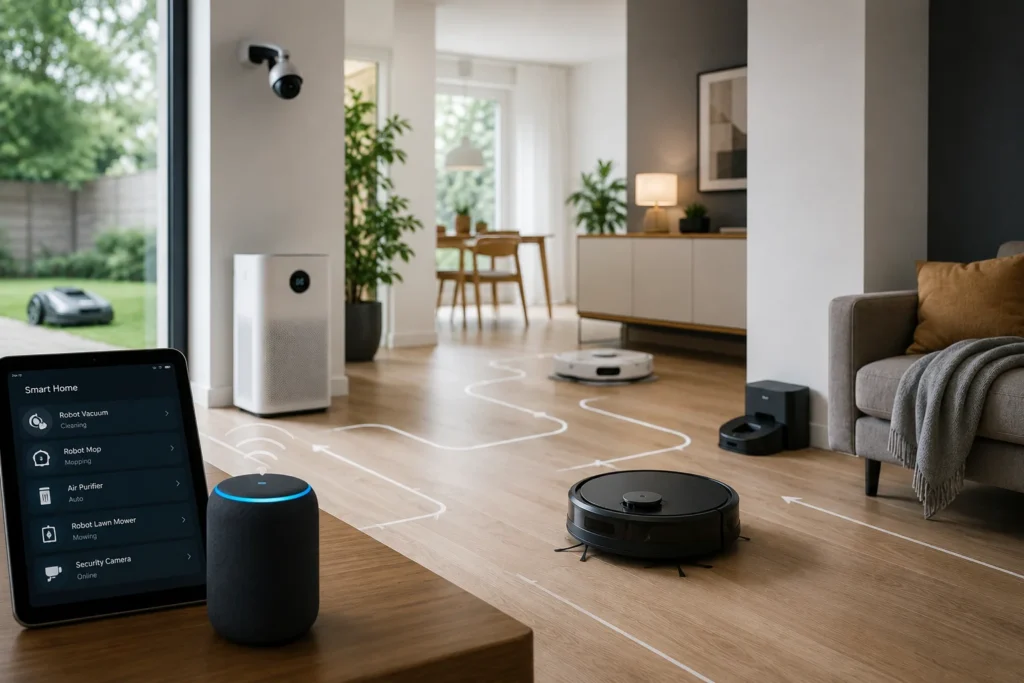
Think about robot vacuums, automatic floor moppers, robotic lawn mowers, pool-cleaning robots, or window-cleaning devices. According to the International Federation of Robotics, robots for domestic tasks such as floor cleaning and lawn mowing are the largest group of consumer robots, with nearly 20 million units sold in 2024.
This tells us something important: the future of home robots will not arrive all at once with a huge “wow” effect. It is already arriving, step by step, through practical devices that solve real problems.
From Science Fiction to Everyday Practicality
When we talk about home robots, we often imagine a humanoid figure walking around the house, understanding everything we say, and completing every task without mistakes. In reality, today’s most useful robots are often much less spectacular, but far more practical.
A robot vacuum, for example, does not completely replace manual cleaning, but it can reduce the time we spend on repetitive chores. A robotic lawn mower does not magically turn a garden into a perfect park, but it can keep the grass under control with less effort. A pool-cleaning robot does not remove every maintenance task, but it can make a job many people find annoying much easier.
The real strength of home robots, at least for now, is not doing everything for us. It is helping us save time, energy, and mental space.
Why Home Robots Are Becoming More Interesting
In recent years, domestic robotics has improved a lot. Devices are better at navigation, more capable of recognizing obstacles, more advanced in mapping indoor spaces, and, in some cases, able to integrate with voice assistants and smart home systems.
The home cleaning robot market keeps growing: IDC estimated 32.72 million units shipped in 2025, up 20.1% year over year. Smart vacuums remain the strongest segment, but robotic lawn mowers, window cleaners, and pool robots are also gaining momentum.
This growth is happening for a simple reason: people do not want technology only because it is new. They want it when it genuinely improves daily life. Cleaning floors, cutting grass, or maintaining certain home spaces are exactly the kind of repetitive tasks that make sense to automate, at least partially.
The Role of Artificial Intelligence
Artificial intelligence is making home robots more interesting, but also more complex. In the past, many robots simply followed relatively rigid patterns. Today, more advanced models can better understand their environment, avoid objects, recognize different surfaces, and adapt their behavior to specific situations.
In the future, AI could allow robots to understand more natural instructions, such as: “clean only the kitchen after dinner” or “go through the living room, but avoid the area where the dog is sleeping”.This kind of interaction will be essential because homes are not clean, predictable environments like factories. Every home is different, every family has different habits, and every day can bring small surprises.
The real challenge will be making robots not only smarter, but also more reliable, discreet, and respectful of people.
Will Humanoid Robots Really Arrive?
Recently, there has been a lot of discussion about humanoid robots for the home. The idea is fascinating: a physical assistant capable of folding clothes, tidying up, moving objects, and performing more complex tasks than a simple robot vacuum.
The problem is that the home is one of the hardest environments for a robot. There are stairs, rugs, pets, children, moved furniture, fragile objects, tight spaces, and unpredictable situations. For a human being, all of this is normal. For a machine, it is extremely difficult.
That is why home humanoid robots will probably arrive gradually and, at least at first, with high prices and limited functions. We should not expect a perfect “robot butler” right away. More realistically, we will see specialized devices that can perform a few specific tasks very well.
The Question of Trust
There is another very important issue: trust. A home robot is not like a smartphone or a computer. It moves through the space where we live, collects environmental data, and may include sensors, microphones, cameras, and maps of the home.
This raises sensitive questions: where does the data go? Who manages it? Can the robot work offline? Are images processed locally or in the cloud? These are questions consumers should start asking before buying.
Convenience matters, but inside the home, privacy matters even more. A good home robot should not only be efficient. It should also be transparent, secure, and respectful of personal life.
Not Just Convenience: Also Assistance
One of the most interesting areas for home robots is assistance for elderly people or people with limited mobility. In the future, some robots could help with medication reminders, monitor risky situations, detect falls, carry small objects, or make communication with family members and caregivers easier.
Of course, technology cannot replace human relationships. No robot should ever become an excuse to leave vulnerable people alone. But it can become a useful support when designed carefully and used in the right way.
In this sense, home robots may become more than expensive gadgets. They could become tools that improve independence, safety, and quality of life.
The Limits We Should Not Ignore
Despite all the progress, it is important to keep expectations realistic. Home robots are not perfect. They can get stuck, misread an obstacle, fail to clean certain corners properly, or still require regular maintenance.
Also, the more advanced a robot is, the more important software updates, technical support, spare parts, and cybersecurity become. A smart home device should not be judged only by what it does on day one, but also by how well it will be supported over time.
Cost is another limitation. Simpler robots are now fairly accessible, but more advanced models can still be expensive. That is why it is always worth asking: what problem does this robot really solve? Will it save me time in a concrete way? Is it suitable for my home?
The Future Will Be Built Step by Step
The future of home robots will probably not be a sudden leap into houses full of androids. It will be a gradual journey made of increasingly intelligent, connected, and specialized devices.
We will see robots that clean better, mow lawns more precisely, recognize spaces, collaborate with other smart home devices, and, over time, perform more complex tasks. The goal should not be to completely replace human beings, but to reduce the burden of repetitive activities and leave more room for what really matters.
Because, in the end, the best technology is not the one that amazes us for a few minutes. It is the one that quietly makes our days a little easier.
Conclusion
Home robots are no longer just a futuristic promise. They are already present in our homes, even if often in simple and specialized forms. Their evolution will be shaped by artificial intelligence, the smart home, data security, and real everyday usefulness.
The question is no longer whether robots will enter our homes. In part, they already have. The real question is: will we be able to choose the ones that are truly useful, safe, and respectful of the way we live?
If the answer is yes, home robots could become not only technological tools, but small allies in everyday life.