Smart homes are supposed to make our lives easier. Yet, between controlling the lights, checking security cameras, adjusting the thermostat, and keeping track of everyone’s schedules, managing a connected home can sometimes become surprisingly complicated.
Apple wants to change that with Apple HomeView, its new smart home hub officially announced on October 13, 2026.
Featuring a 7-inch Liquid Retina display, a redesigned Siri powered by Apple Intelligence, facial recognition, and deep integration with Apple’s ecosystem, HomeView brings several everyday tasks together in one device.
But there’s an important question worth asking: with Amazon and Google already offering established smart home displays, can Apple’s latest innovation really bring something new to the table?
Let’s explore what HomeView offers, how much it costs, and whether it deserves a place in your home.
What Is Apple HomeView, and How Does It Work?
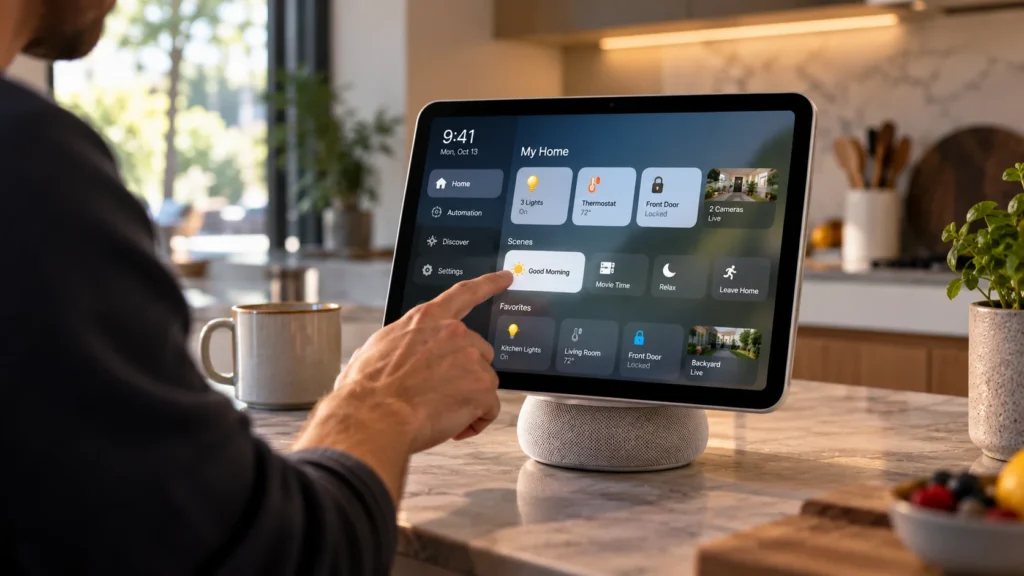
Apple HomeView is a smart display designed to act as a central control point for your connected home. Think of it as a combination of a HomePod, an intelligent digital assistant, and a convenient touchscreen that helps you manage your daily routine.
At first glance, its design is unmistakably Apple.
The tabletop version features a 7-inch Liquid Retina display attached to a rounded speaker base through an adjustable stainless steel hinge. Its aluminum construction gives it a clean, modern appearance that should fit comfortably into most living spaces.
Apple has also introduced a wall-mounted version, making HomeView suitable for kitchens, hallways, and entryways where a permanent smart home control panel might be particularly useful.
The display includes True Tone technology and automatic brightness adjustment, allowing it to adapt to different lighting conditions throughout the day.
However, HomeView isn’t just about attractive hardware.
Imagine walking into your kitchen in the morning and immediately seeing your appointments, the day’s weather, and reminders for things you need to get done. While preparing breakfast, you could ask Siri to play some music, adjust the temperature, or show who’s ringing your doorbell.
It’s these simple, everyday interactions that Apple hopes will make HomeView feel like a genuinely useful household companion.
Apple HomeView Features: What Makes It Different?
HomeView brings several technologies together, but its most interesting features focus on personalization, artificial intelligence, and making connected devices easier to manage.
A Smarter Siri Powered by Apple Intelligence
One of the biggest improvements is the introduction of Siri AI, Apple’s redesigned voice assistant.
Unlike earlier versions of Siri, which sometimes struggled with complex requests, the new assistant is designed to support more natural conversations, understand what’s happening on the screen, and provide more detailed answers.
For example, you could ask Siri to help organize your day, find a song you only vaguely remember, or explain something you’re curious about while cooking dinner.
When paired with a compatible Apple Intelligence-enabled iPhone or iPad, HomeView can also use personal context from supported apps, including Calendar and Messages.
That means Siri can provide assistance based on information that’s actually relevant to you rather than offering only generic responses.
Of course, these capabilities will need to prove themselves in real-world testing. Siri AI is launching in beta, and the quality of its responses will be an important factor in determining how useful HomeView becomes.
Facial Recognition for the Whole Family
One particularly thoughtful Apple HomeView feature is its ability to recognize different people through facial recognition.
The device supports personalized experiences for up to six users, automatically adjusting its Home Screen, apps, and widgets depending on who’s standing in front of it.
This could be especially helpful for families.
A parent might see upcoming work appointments, while another family member gets their own reminders or favorite music recommendations.
Apple has also included privacy protections that help keep personal information from appearing in front of other household members.
Sensitive content from applications such as Messages and Calendar requires the recognized user’s paired iPhone or iPad to meet additional security conditions.
It’s a useful balance between making a shared device convenient and respecting the privacy of everyone who uses it.
A Central Dashboard for Your Smart Home
Controlling connected accessories is another major part of the Apple HomeView experience.
Through the touchscreen or voice commands, users can manage compatible lights, thermostats, smart locks, blinds, and security cameras.
Imagine returning home after a long day. Rather than opening several apps, you could simply ask Siri to create a relaxing atmosphere by dimming the lights and adjusting the thermostat.
HomeView also supports compatible Matter accessories, helping it work with smart home products from different manufacturers.
For security monitoring, the device can display up to nine compatible camera feeds simultaneously.
That could be particularly useful for checking a front door, backyard, driveway, or other areas without switching between individual camera applications.
Apple has also announced its Home Collection, a range of connected home accessories developed with partners including LG Electronics and Schneider Electric.
These accessories will begin arriving in December 2026, with additional products scheduled for early 2027.
Entertainment, FaceTime, and Everyday Convenience
Although Apple HomeView is primarily positioned as a smart home hub, its capabilities extend well beyond home automation.
The integrated audio system supports Spatial Audio, while Apple Music, Apple Podcasts, and compatible entertainment apps provide easy access to music and other content.
FaceTime support with Center Stage makes video calls more convenient, particularly when several people are moving around the room.
The kitchen could be one of the places where HomeView proves most useful.
Instead of constantly touching your phone while preparing food, you can display recipes, follow step-by-step cooking instructions, and manage timers using voice commands.
HomeView can also display shared family photos, help locate misplaced devices through Find My, and send Intercom messages to other compatible Apple devices around the house.
Individually, many of these capabilities are already familiar to Apple users. The appeal comes from bringing them together in a shared household device that remains accessible throughout the day.
Apple HomeView Privacy and Security
Whenever a new device introduces cameras, microphones, and personalized AI features into the home, privacy naturally becomes an important concern.
Apple has made security one of HomeView’s defining features.
The device is powered by the A18 chip and includes protected processing environments known as Secure Exclaves, which isolate sensitive camera and microphone processing from other parts of the system.
Siri requests can also use on-device processing or Apple’s Private Cloud Compute infrastructure.
According to Apple, information handled through Private Cloud Compute isn’t stored or made accessible to Apple.
HomeView additionally supports compatible HomeKit Secure Video cameras, offering encrypted monitoring capabilities and intelligent recognition of people, pets, vehicles, and packages when the required services are enabled.
Some advanced features require an eligible iCloud+ subscription and compatible Apple Intelligence hardware.
While these protections are encouraging, users should still follow basic security practices, such as keeping their devices updated and protecting their Apple Accounts.
A smart home should make people feel more comfortable and secure, not introduce unnecessary uncertainty about how their personal information is handled.
Apple HomeView vs. Amazon Echo Show and Google Nest Hub
Apple is entering a competitive market where Amazon and Google have already spent years developing smart displays and connected home ecosystems.
So how does Apple HomeView compare?
Amazon’s Echo Show lineup offers smart home management, entertainment, video calling, and access to Alexa-supported services. Its broad accessory compatibility and range of hardware options make it appealing to different kinds of households.
Google’s Nest Hub focuses on smart home controls, entertainment, Google services, and convenient access to household information. The second-generation Nest Hub features a 7-inch touchscreen and supports Matter-compatible accessories.
Apple’s approach places greater emphasis on personalized experiences, integration with its own devices, and Siri AI.
For households that already use iPhones, iPads, HomePods, and Apple Home accessories, HomeView could feel like a natural extension of their existing technology.
However, Apple faces two important challenges.
The first is compatibility. While Matter support helps connect products from different manufacturers, users with extensive Alexa or Google Home setups should verify that their existing accessories can work with Apple Home.
The second is price.
At $299, HomeView costs considerably more than some entry-level competing smart displays. For comparison, Google’s second-generation Nest Hub is listed at $99.99 in the US Google Store.
That makes Apple’s proposition less about providing the cheapest smart display and more about delivering a premium experience through its ecosystem.
Whether that additional investment is worthwhile will depend on how often buyers use the personalized features and whether Siri AI performs consistently in everyday situations.
Apple HomeView Price and Release Date
Apple HomeView starts at $299 in the United States, with both the tabletop model and wall-mounted version carrying the same starting price.
Preorders began on October 13, 2026, and general availability is scheduled for November 13, 2026.
The tabletop model is available in four finishes: silver, starlight, rose pink, and space gray. The wall-mounted version comes in silver and space gray.
Wall-mounting hardware is sold separately, with Schneider Home accessories starting at $59.95.
Initial availability includes the United States, United Kingdom, Canada, Australia, India, New Zealand, Singapore, and South Africa.
Unfortunately, there’s disappointing news for Apple enthusiasts in Europe.
Will Apple HomeView Be Available in Europe?
Apple has confirmed that HomeView will not initially be available for sale in the European Union because Siri AI is currently unavailable on iOS in the region.
The company says it is working toward a solution, but no official EU release date has been announced.
For customers in Italy and other EU countries, this means there’s currently no confirmed timeline for purchasing the device through Apple’s local retail channels.
It’s an important limitation, especially considering how central Siri AI is to the HomeView experience.
Is Apple HomeView Worth Buying?
The answer depends largely on what your current smart home looks like.
If you already own an iPhone, regularly use Apple services, and have compatible smart home accessories, HomeView could become a convenient addition to your daily routine.
It offers a more accessible way to manage household devices, communicate with family members, and view personalized information without constantly reaching for your phone.
Its ability to recognize multiple people could also be especially useful in shared homes.
On the other hand, if you’re primarily invested in Google’s or Amazon’s ecosystems, switching to HomeView might not provide enough practical benefits to justify the expense.
The $299 price makes it a considered purchase rather than an inexpensive smart home accessory.
And while Apple’s redesigned Siri sounds promising, some of its most ambitious capabilities are still in beta or depend on compatible devices and services.
For that reason, it may be sensible to see how HomeView performs in independent reviews once it reaches customers.
Final Thoughts: Can Apple HomeView Challenge Amazon and Google?
Apple HomeView is an interesting step forward for Apple’s smart home ambitions.
Rather than introducing another standalone gadget, the company is trying to create a more connected, personalized experience around the devices people already use.
The combination of facial recognition, Siri AI, HomeKit integration, entertainment, and privacy-focused technology gives HomeView a clear identity.
But Amazon and Google aren’t standing still. Both have established smart home ecosystems, recognizable products, and years of experience in this market.
Apple will need to demonstrate that its premium approach delivers meaningful advantages beyond polished design and convenient integration.
Ultimately, Apple HomeView has the potential to become a compelling smart home hub, particularly for households already invested in Apple’s ecosystem.
What matters most isn’t how many features Apple can fit into a 7-inch screen. It’s whether those features genuinely make everyday life simpler.
And if HomeView can accomplish that consistently, Apple may have found a very convincing reason for people to bring another screen into their homes.