Apple and Meta are putting their differences aside to explore a new chapter in artificial intelligence. With Muse Spark Open on Mac, powerful AI models are moving closer to our personal computers, opening up exciting possibilities for performance, privacy, and the future of everyday technology.
When you think about Apple and Meta, a close partnership probably isn’t the first thing that comes to mind. The two technology giants have spent years disagreeing over privacy, advertising, and the way our digital lives should work. Yet artificial intelligence is creating unexpected opportunities for collaboration, and their latest efforts demonstrate just how quickly the industry is evolving.
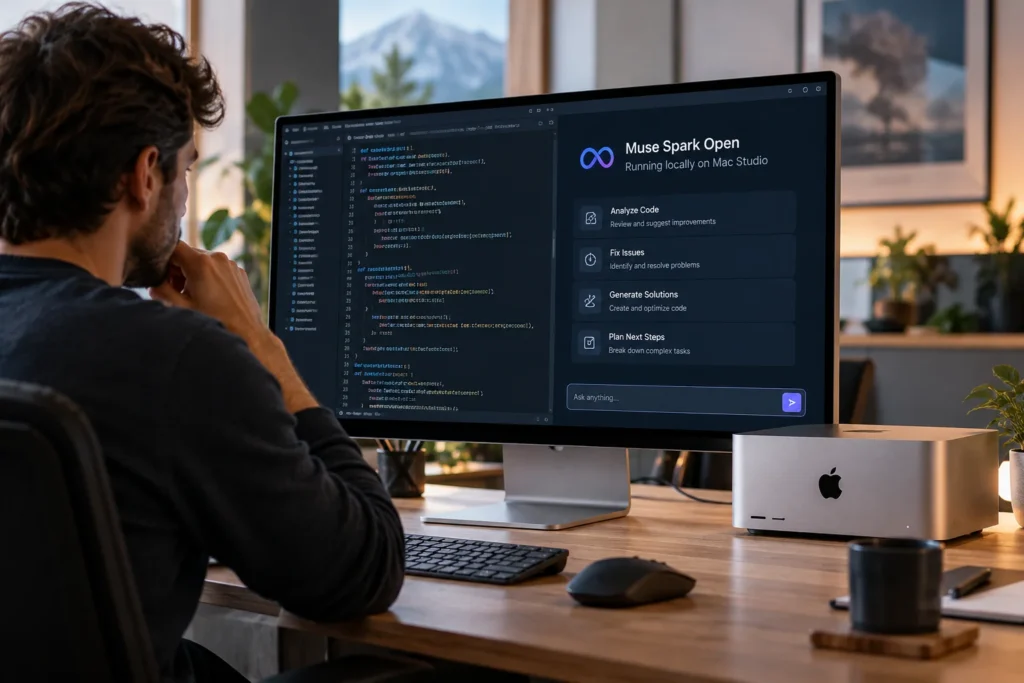
On October 15, 2026, Meta introduced Muse Spark Open, an advanced AI model designed to handle demanding tasks such as software development, complex reasoning, and automated workflows. What makes this announcement particularly interesting is its compatibility with Apple’s powerful Mac Studio computers, allowing developers to run an exceptionally sophisticated AI model on locally controlled hardware rather than relying entirely on remote cloud servers. Muse Spark Open on Mac represents an important step toward a future where powerful artificial intelligence could become more accessible, independent, and personal.
What Is Muse Spark Open, and Why Does It Matter?
Muse Spark Open is an advanced artificial intelligence model developed by Meta to tackle tasks that require significant processing power and the ability to understand large amounts of information. While most people are familiar with AI assistants that answer questions, generate text, or summarize documents, Muse Spark Open is designed to support more complicated workflows, particularly those involving programming, reasoning, and multiple connected operations.
The model features an impressive 816 billion total parameters, although approximately 42 billion are activated during each token-generation step. It also supports a context window of up to one million tokens, allowing it to work with extremely large documents, extensive software projects, and other information-heavy tasks. These numbers might sound overwhelming, but the underlying concept is straightforward: Meta wants to give developers access to powerful AI technology capable of handling sophisticated assignments without necessarily depending on a conventional cloud-based service.
Imagine a developer working on a complex application containing thousands of files. Instead of manually reviewing every section of code, they could use an AI assistant to analyze the project, identify potential errors, suggest improvements, and assist with implementing changes. This is the kind of practical application that makes advanced AI models increasingly valuable, particularly when developers have greater control over how and where the technology operates.
Why Muse Spark Open on Mac Is Such an Important Development
Running a massive artificial intelligence model requires extraordinary computing resources. Traditionally, systems of this size have depended on specialized servers and data centers equipped with powerful processors and enormous amounts of memory. Apple’s Mac Studio offers an interesting alternative thanks to the company’s continued investments in Apple silicon and its unified memory architecture.
The M5 Ultra processor provides the computing capabilities needed for demanding professional workloads, while unified memory allows different processing components to access a shared pool of resources. This architecture is especially useful for artificial intelligence because large models need substantial memory to store and process information efficiently. By connecting multiple Mac Studio computers, developers can combine their resources and distribute demanding calculations across several machines.
According to Meta’s technical documentation, Muse Spark Open can operate locally using two M5 Ultra Mac Studios equipped with 512GB of unified memory each. Apple has also demonstrated a configuration involving four Mac Studios capable of generating more than 36 tokens per second during testing. These results highlight the growing potential of desktop-class hardware, although the necessary equipment remains far beyond what most consumers would typically purchase.
The broader significance is that increasingly powerful AI systems are no longer restricted to conventional data center environments. While local deployment still requires substantial investment, developments like this could encourage new approaches to building and using artificial intelligence.
Local AI on Mac: A New Opportunity for Privacy
One of the most promising aspects of Muse Spark Open on Mac is the possibility of processing information locally. Today, many popular AI services depend on cloud infrastructure, meaning user requests and uploaded information may be transmitted to remote servers for processing. This approach offers convenience and access to powerful computing resources, but it can also raise questions about how sensitive information is handled.
Local artificial intelligence provides an alternative. When an AI model runs directly on hardware controlled by the user or organization, documents and other information can potentially be processed without being sent to an external AI provider. This could be particularly useful for businesses managing confidential records, researchers handling sensitive material, or developers working on proprietary software projects.
Of course, running an AI model locally doesn’t automatically guarantee complete privacy or security. Applications may still communicate with external services, and protecting information depends on software configuration, permissions, and appropriate security measures. Nevertheless, local processing can provide additional control over where information is handled and who can access it. As artificial intelligence becomes increasingly integrated into everyday activities, that level of control could become an important consideration for both individuals and businesses.
Apple and Meta: An Unexpected Partnership
The relationship between Apple and Meta has never been particularly simple. Over the years, the companies have taken noticeably different approaches to digital advertising, user tracking, and privacy. Apple’s App Tracking Transparency policies, for example, created significant disagreements between the two technology giants, reflecting their contrasting business priorities.
That’s what makes their cooperation around Muse Spark Open particularly noteworthy. Meta benefits from making its AI technology available to developers working with Apple’s powerful hardware, while Apple gains another opportunity to demonstrate the capabilities of its processors and machine learning ecosystem. Both companies have strong incentives to support advanced AI development, even when their broader business strategies remain very different.
Rather than representing a complete change in their relationship, this cooperation illustrates how artificial intelligence can create common interests between companies that compete in other areas. For developers and researchers, the result is potentially more flexibility when choosing the hardware and software used to build new applications.
How Apple’s MLX Framework Supports Advanced AI
An important part of this technological achievement involves MLX, Apple’s open-source machine learning framework designed specifically for Apple silicon. MLX helps developers build, optimize, and run AI models while taking advantage of the unique architecture of Apple’s processors.
For Muse Spark Open, the framework makes it possible to distribute processing tasks across multiple Mac Studio computers. By combining available memory and computing resources, developers can operate models that would otherwise be too demanding for a single machine. Fast connections between computers help support the communication needed for this kind of distributed processing.
Although this technology is primarily aimed at developers and researchers, its implications extend beyond one particular AI model. Improvements in machine learning frameworks can support a broader ecosystem of applications, potentially making advanced AI more efficient and easier to deploy in the future.
Can You Run Muse Spark Open on Your MacBook?
For anyone who owns a MacBook Air, MacBook Pro, or Mac mini, the obvious question is whether Muse Spark Open can run on their existing computer. Unfortunately, the full model currently requires significantly more memory and processing power than typical consumer Macs can provide.
The recommended local configurations involve multiple high-end Mac Studio systems, making this technology primarily suitable for professional developers, research institutions, and organizations with substantial computing requirements. However, that doesn’t mean ordinary Mac users are excluded from the broader development of local AI.
Smaller artificial intelligence models can already operate on compatible personal computers, and software optimization continues to improve their efficiency. As processors become more capable and machine learning techniques evolve, it’s reasonable to expect increasingly sophisticated AI applications to become available on less expensive hardware. Muse Spark Open may not be designed for the average MacBook today, but the technologies supporting it could help shape future generations of consumer AI tools.
Why Open-Weight AI Matters for Developers
Another interesting aspect of Muse Spark Open is its open-weight approach. Unlike AI systems available exclusively through proprietary online services, open-weight models allow developers to obtain trained model weights and deploy them in compatible environments, subject to applicable licensing conditions.
This provides opportunities for customization, experimentation, and the development of specialized applications. For example, a software company might explore using a locally deployed model to assist with code reviews, automate repetitive development tasks, or analyze internal documentation. Researchers could investigate how the model performs on particular problems and experiment with different configurations.
However, open-weight doesn’t necessarily mean completely open-source or unrestricted. Developers still need to understand the model’s license and any conditions governing commercial use, redistribution, or modification. Even with those considerations, broader access to advanced AI models can encourage innovation by allowing more people to experiment with technology that might otherwise remain accessible only through centralized services.
What Does This Mean for the Future of Apple Computers?
For many years, improvements in personal computing have focused on faster processors, better graphics, and increasingly efficient hardware. Artificial intelligence introduces another dimension to that evolution: computers that can assist with complicated tasks rather than simply executing individual instructions.
Imagine a creative professional using an AI assistant to organize video footage, identify relevant clips, and support the editing process. A programmer could ask a local model to examine a large software project, while a business owner might use artificial intelligence to analyze documents and generate useful summaries without relying entirely on external services. These examples illustrate how AI could gradually become a more integrated part of everyday computing.
It’s important to remember that Muse Spark Open isn’t announcing a collection of new consumer features for macOS. Instead, it demonstrates what’s becoming possible when advanced AI software is combined with powerful local hardware. Developers will ultimately determine how these capabilities translate into practical applications, and the most useful innovations may emerge gradually as the technology becomes more efficient.
Will Local AI Eventually Replace Cloud-Based Services?
Although local artificial intelligence offers several advantages, cloud computing is unlikely to disappear. Remote infrastructure remains extremely useful for demanding workloads, large-scale services, and users who don’t want to invest in expensive computing hardware. Cloud platforms can provide access to advanced models from virtually any compatible device, making sophisticated AI technology available to a much wider audience.
Local AI, on the other hand, can offer greater control over information processing and reduce dependence on remote infrastructure for supported tasks. The future will probably involve a combination of both approaches, allowing users and developers to choose the most appropriate option depending on performance requirements, privacy considerations, convenience, and cost.
This flexibility could become increasingly important as artificial intelligence moves beyond simple conversations and begins supporting more complex professional and personal activities. Rather than relying on a single approach, future computers may intelligently combine local processing with cloud-based resources to deliver more capable and practical experiences.
Final Thoughts: Muse Spark Open on Mac Could Be the Beginning of Something Bigger
The arrival of Muse Spark Open on Mac highlights an important shift in the artificial intelligence industry. Powerful AI models are becoming increasingly adaptable, and desktop computers are beginning to play a more significant role in workloads once associated almost exclusively with specialized data centers.
For now, running Muse Spark Open locally requires expensive hardware and considerable technical expertise, making it a solution primarily aimed at professionals and researchers. However, the underlying progress is encouraging. As computing hardware improves and AI models become more efficient, technologies that currently seem out of reach could gradually influence the applications available to everyday users.
Perhaps the most exciting possibility isn’t simply having more powerful artificial intelligence. It’s having greater freedom to decide how that intelligence works, where our information is processed, and how much control we maintain over the technology we use.
Muse Spark Open on Mac is more than an impressive technical demonstration. It’s another indication that the future of personal computing may involve smarter, more independent computers that can accomplish more while giving users greater control over their digital lives. And that is a development worth following.