The smart home entered our lives almost quietly. First came a light bulb controlled from a smartphone, then a voice assistant on the nightstand, a security camera by the front door, and a smart thermostat designed to manage energy use more efficiently. Little by little, what once felt like a tech curiosity has become part of everyday life.
Turning on the lights without getting off the couch, adjusting the temperature before coming home, or asking a voice assistant to set a timer while cooking may seem like small things. But they explain very well why smart home technology is so appealing: it makes daily life more comfortable, simpler, and sometimes even more efficient.
Still, one question remains: does the smart home really give us more freedom, or does it risk making us too dependent on technology?
Convenience is its strongest point
The main reason people choose smart home devices is simple: they make life easier. A smart light can be programmed to turn on at sunset. A smart thermostat can adapt to a family’s habits. A connected camera can help you check the front door while you are away from home.
These are solutions that speak directly to real life. They can help someone who comes home late from work, someone who wants the house warm before arriving, or someone who has children, pets, or elderly relatives to keep an eye on. In these cases, technology is not just a gadget. It becomes a small daily support system.
Voice assistants have also changed the way we interact with our homes. You no longer need to open a different app for every action. You can simply say a sentence: “Turn on the kitchen light”, “lower the heating”, or “set a reminder”. The benefit is not only practical, but immediate. Technology almost disappears into the background and leaves room for action.
Savings are possible, but expectations matter
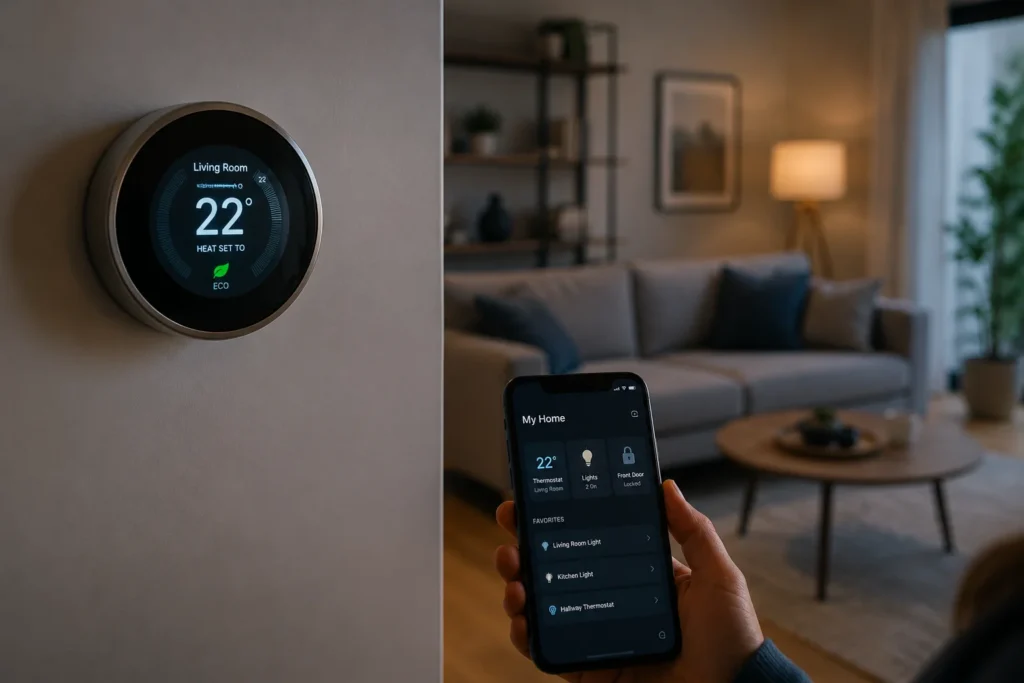
Energy savings are one of the most common arguments in favor of smart homes. Thermostats, smart plugs, and sensors can help reduce waste, especially when used properly. Automatically turning off lights, preventing heating from running when it is not needed, or monitoring electricity consumption can make a difference over time.
That said, it is better not to expect instant miracles. A smart home can help optimize energy use, but it cannot turn an inefficient house into a highly efficient one by itself. Much depends on insulation, daily habits, the type of heating system, and the quality of the devices installed.
In other words, technology is a tool. It can be very useful, but it works best when combined with conscious habits and a realistic understanding of the home itself.
The price of convenience
The first practical limitation is cost. A single smart bulb may seem affordable, but once you start adding cameras, sensors, hubs, speakers, locks, thermostats, and smart plugs, the total expense can rise quickly.
There is also another important factor: not all devices work perfectly together. Some are better suited to one ecosystem, while others work better with another. People using Apple, Google, Amazon, or Samsung products may face different levels of compatibility, different apps, and small compromises along the way.
In recent years, standards designed to improve interoperability have made the smart home market more organized, but choosing the right products still matters. Before buying a smart device, it is worth asking a few simple questions: will it work well with what I already own? Does it need a hub? Will it receive updates over time? Can it still work if the Internet goes down?
Simple questions like these can prevent impulsive purchases and future frustration.
Privacy: the invisible side of the smart home
A smart home runs on data. It may know when we turn on the lights, when we are home, what temperature we prefer, when a door opens, and sometimes even what we say to a voice assistant. These details are not always dangerous, but they are still information about our private lives.
The point is not to demonize technology, but to understand what we are bringing into our homes. A connected camera can be useful, but it needs to be configured properly. A voice assistant can be convenient, but users should know how recordings are handled. A smart home app may look harmless, but it can sometimes ask for permissions that are not strictly necessary.
That is why it is important to choose reliable brands, use strong passwords, enable two-factor authentication when available, and keep devices updated. When possible, separating smart home devices from the main home network can also be a good security practice.
Privacy in a smart home should not become paranoia. It should become awareness.
What happens when the Internet stops working?
This is one of the most important questions, and it is often overlooked. What happens if the connection goes down? Do the lights still work? Does the thermostat continue to regulate the temperature? Can the smart lock still be opened manually? Does the camera record locally, or does it become useless?
A smart home should still be a home first. If turning on a lamp always requires an online server, something is not ideal. The best smart systems are those that keep essential functions available even without an Internet connection.
This does not mean giving up remote control or advanced automations. It simply means designing a smart home with common sense. Critical functions, such as main lights, heating, locks, and alarms, should always have a manual or local alternative.
Technology should add convenience, not remove autonomy.
Convenience or dependence?
The most honest answer is: it depends on how we use it.
A well-designed smart home can genuinely improve quality of life. It can save time, reduce small forms of waste, increase the feeling of security, and make home management easier. For some people, it can also be a real source of support, especially for those with mobility challenges, large families, or specific remote monitoring needs.
The risk begins when every action becomes mediated by technology. When we no longer know how to turn on a light without an app, when a missing connection blocks basic tasks, or when we buy smart devices only because they look impressive rather than because they solve a real problem.
The best smart home is not the one filled with the most devices. It is the one that solves real problems without making life more complicated.
How to build a truly smarter home
The best approach is to start gradually. There is no need to automate everything. You can begin with what brings a real benefit: a thermostat if you want better heating control, a few smart lights in the most used rooms, a camera only where it truly makes sense, or a smart plug to monitor a specific appliance.
It is better to choose compatible, updatable, and easy-to-manage products. It is also wise to avoid extremely cheap devices if they do not offer basic guarantees in terms of security and support. Most importantly, it is worth asking one question before every purchase: does this device truly make my life easier?
Because when technology is well designed, it should not make us feel more dependent. It should make us feel more at ease.
Conclusion
The smart home is neither magic nor a threat. It is a tool. It can make a home more comfortable, efficient, and secure, but only if it is chosen and configured carefully.
The goal is not to have a house that does everything by itself. The goal is to have a home that helps us without completely replacing us. A smart home should respect our habits, protect our privacy, and continue to work even when technology reaches its limits.
In the end, true intelligence is not only inside the devices. It is in the way we choose to use them.