Apple Intelligence is becoming considerably more powerful with iOS 27, iPadOS 27, and macOS 27. But alongside smarter AI tools and a much more capable Siri, Apple has introduced something users of services like ChatGPT may already know well: usage restrictions.
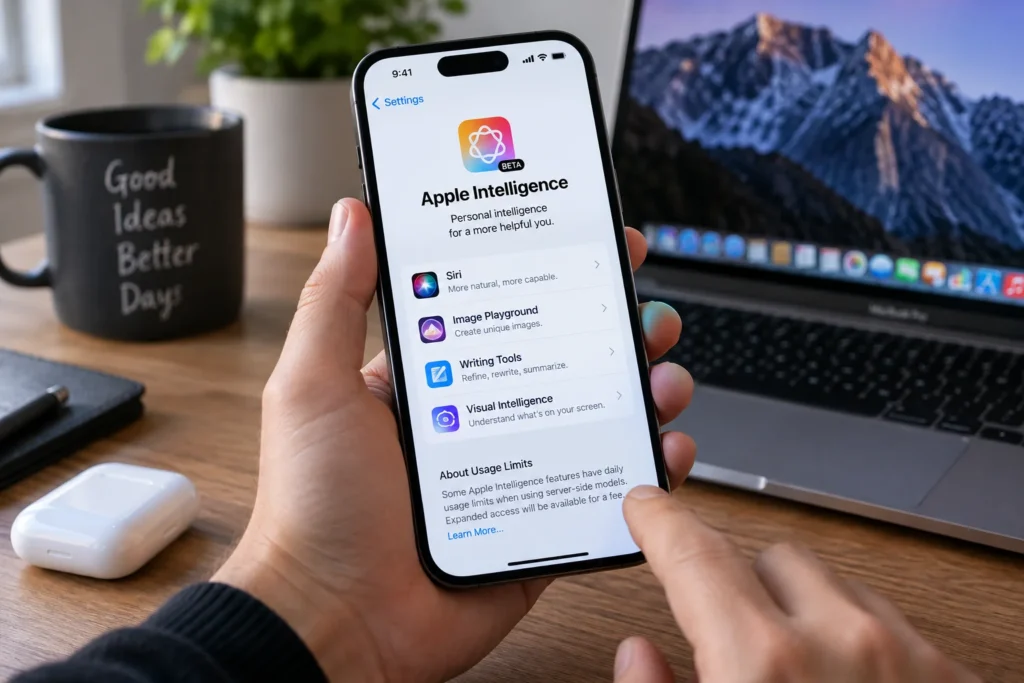
The new Apple Intelligence daily limits apply to certain features that depend on Apple’s server-side AI models rather than running entirely on the device.
And there is another important detail.
Apple has confirmed that expanded access to some of these server-based features will eventually be available for a fee.
At first glance, this might sound like a relatively minor technical limitation. In reality, it points toward a much bigger question for the technology industry: is premium AI becoming inevitable?
Apple Intelligence Is Entering a New Phase
Apple’s latest software generation represents a significant step forward for Apple Intelligence.
With iOS 27, iPadOS 27, macOS 27, watchOS 27, and visionOS 27, Apple is introducing its next generation of AI features across supported devices.
One of the biggest changes is Siri AI, a much more capable version of Apple’s assistant designed to understand personal context, interact more naturally, recognize what is happening on screen, and perform actions across apps.
Apple has also expanded its AI capabilities in areas such as intelligent photo editing, Image Playground, Safari, Shortcuts, and its Apple Foundation Models.
But there is an important technical distinction behind all these features.
Not everything happens directly on your iPhone, iPad, or Mac.
Some requests can be processed locally, while more computationally demanding tasks may rely on Apple’s cloud infrastructure and server-side models.
That distinction is becoming increasingly important.
Why Some Apple Intelligence Features Have Daily Limits
Running artificial intelligence locally has several advantages.
It can be faster, work without constantly communicating with a remote server, and offer additional privacy benefits.
However, smartphones and laptops have obvious limitations.
Even modern chips have finite memory, processing power, battery capacity, and thermal limits. There are AI tasks that are simply much easier to perform using much larger models running inside powerful data centers.
That is where server-side AI becomes useful.
The downside is cost.
Every time millions of people send complex requests to cloud-based AI models, those requests require processing power, networking infrastructure, electricity, cooling, and expensive hardware.
Unlike many traditional software features, cloud AI creates an ongoing cost every time people use it.
That helps explain why Apple Intelligence daily limits now exist.
Which Apple Intelligence Features Are Limited?
Apple says certain Apple Intelligence features that depend on server-side models are subject to daily usage limits.
Examples include Siri AI, intelligent photo-editing tools, Image Playground, and AFM 3 Cloud models available through Shortcuts.
Importantly, Apple has not announced a simple universal rule such as “50 requests per day”.
Instead, the company says limits can vary depending on the feature, the complexity of the request, system demand, system policies, and other factors.
That makes sense from a technical perspective.
Generating an image is not necessarily equivalent to asking Siri a relatively simple question. Likewise, running an advanced AI workflow through Shortcuts may require far more computational resources than completing a basic everyday request.
Rather than counting every interaction equally, Apple appears to be treating cloud AI as a computational resource whose consumption depends on what the user is actually asking the system to do.
On-Device Apple Intelligence Is Different
There is an important distinction users should understand.
The introduction of Apple Intelligence daily limits does not mean every Apple Intelligence feature suddenly stops working after a certain number of requests.
A significant part of Apple’s AI strategy continues to revolve around on-device processing.
When a task can be handled locally by the Apple Foundation Models running on compatible hardware, there is no need to send that workload to Apple’s servers.
That approach brings several potential benefits.
Responses can be faster, some features can continue working without a constant internet connection, and less information needs to leave the device in the first place.
Server-side processing becomes necessary when the request requires significantly more computational power.
For the average user, this distinction may remain almost invisible most of the time.
The device simply determines how the request should be processed.
The difference only becomes particularly noticeable when server usage limits are reached.
Apple Has Already Opened the Door to Paid AI Access
This is arguably the most interesting part of Apple’s announcement.
The company has explicitly said that expanded access to certain server-based Apple Intelligence features will be available for a fee.
Apple has not announced one universal standalone subscription called something like “Apple Intelligence Pro”.
At least for now, the situation is more nuanced.
Apple previously indicated that increased access to certain Apple Intelligence functionality is available through most iCloud+ subscription plans. Its latest announcements also make it clear that additional paid access to server-side capabilities will play a role going forward.
That leaves Apple with several options.
Higher AI allowances could become another advantage of iCloud+ subscriptions. Different iCloud+ tiers could potentially provide different levels of access, or Apple could eventually introduce additional AI-specific plans for particularly demanding users.
Whatever form it takes, one thing is becoming increasingly clear: unlimited access to advanced cloud AI should no longer be assumed.
Why Premium AI Is Becoming So Common
Apple is certainly not alone.
The broader AI industry has already moved toward subscription-based access.
Many generative AI services provide a free tier with restrictions while reserving more powerful models, higher limits, faster processing, or additional features for paying subscribers.
There is a practical reason behind this business model.
AI infrastructure is expensive.
A traditional piece of software can often be developed, installed, and then used repeatedly with relatively little additional cost to the developer each time someone clicks a button.
Cloud-based generative AI works differently.
Every prompt requires computation.
Every generated image requires computation.
Every complex analysis requires computation.
Every AI assistant performing several actions on behalf of a user requires even more computation.
Multiply that by hundreds of millions of devices and the economics become difficult to ignore.
Companies have to decide who pays for that processing power.
Increasingly, the answer seems to be a combination of the company itself, advertising or ecosystem revenue, and premium subscriptions for people who use AI more heavily.
The Bigger Question: Should AI Be Included With the Device?
This is where things become more complicated from a consumer perspective.
When someone purchases a premium smartphone or laptop, there is a reasonable expectation that the features advertised with that product will remain available.
An iPhone can already cost well over $1,000 depending on the model and configuration.
Consumers may understandably be less enthusiastic about discovering that some of the device’s most advanced features require yet another recurring subscription to use extensively.
At the same time, there is a meaningful difference between traditional device functionality and large-scale cloud computing.
Apple is not simply unlocking software that already exists inside the phone.
When a request requires powerful remote infrastructure, there is an ongoing cost associated with providing that service.
Both perspectives are understandable.
Apple therefore has to find a balance that feels fair.
Free Limits Could Make or Break the Experience
The most important factor may not actually be whether Apple charges for increased AI access.
It may be how generous the standard limits are.
Imagine that an average iPhone owner uses Siri AI several times throughout the day, occasionally edits a photo, and creates an image every once in a while.
If that person never encounters a usage warning, the existence of a daily limit becomes almost irrelevant.
Heavy users could pay for additional capacity while everyone else continues using Apple Intelligence normally.
That could be a reasonable compromise.
The situation changes dramatically if ordinary users regularly encounter messages informing them that they have reached their daily allowance.
At that point, Apple Intelligence could begin to feel less like an integrated operating-system feature and more like a subscription service attached to a device.
That difference may determine how consumers react to Apple’s strategy.
Subscription Fatigue Is a Real Problem
There is also a broader issue the technology industry cannot ignore.
Consumers already have subscriptions for almost everything.
Music, movies, cloud storage, productivity applications, gaming, password managers, news, fitness platforms, video editing tools, and countless other digital services increasingly require monthly payments.
Adding premium AI access to that list may create even more subscription fatigue.
Individually, many of these subscriptions may appear inexpensive.
Together, they can become a significant monthly expense.
That means companies like Apple will need to demonstrate that additional AI access provides enough value to justify another recurring payment — or successfully integrate it into subscriptions customers already use.
Bundling higher AI limits with iCloud+ could therefore make considerably more sense than introducing yet another isolated monthly service.
Privacy Remains Central to Apple’s Strategy
Apple’s approach to cloud AI is also somewhat different from simply sending every request to a conventional remote chatbot.
For demanding requests, Apple can use its Private Cloud Compute architecture.
Private Cloud Compute was designed to extend the privacy and security principles of Apple’s devices into cloud-based AI processing.
Apple says data sent to Private Cloud Compute is used only to fulfill the user’s request and is not retained afterward for unrelated purposes.
This hybrid architecture is important because Apple is essentially trying to solve two problems at once.
It wants access to powerful cloud-scale AI models without abandoning the privacy-focused approach that has become a major part of the company’s identity.
The result is a combination of local AI and cloud AI rather than a completely cloud-dependent system.
And over time, that balance could become one of Apple’s biggest advantages.
European Users May Have a Different Experience
Regional availability also matters.
Apple Intelligence features are not necessarily identical everywhere in the world.
In the European Union, for example, Siri AI is initially available on supported Macs and Apple Vision Pro devices configured with supported languages, while availability on iPhone, iPad, and Apple Watch is more restricted at launch.
Other Apple Intelligence capabilities may also differ depending on the device, language, country, and regulatory requirements.
That means discussions about Apple Intelligence daily limits should always consider that two users in different regions may not necessarily have access to exactly the same AI experience.
Apple is continuing to expand availability, but regional differences remain part of the rollout.
Is Premium AI Becoming Inevitable?
Probably at least for the most computationally demanding features.
That does not mean every AI tool will eventually require a subscription.
In fact, the opposite may happen with many everyday features.
Apple Silicon continues to improve, smaller AI models are becoming more capable, and increasingly sophisticated tasks can now run directly on consumer hardware.
Over time, more intelligence may move onto our devices.
But at the same time, the most advanced AI systems are becoming larger and more demanding.
Advanced reasoning, realistic image generation, multimodal analysis, autonomous assistants, complex personal context, and AI agents capable of performing multiple actions can require enormous computational resources.
Giving hundreds of millions of users unrestricted access to that level of processing indefinitely may simply not be sustainable.
The likely future is therefore a hybrid one.
Basic and everyday AI may increasingly become part of the device itself, while the most powerful cloud-based capabilities sit behind usage limits or premium tiers.
The Real Test Is Whether Users Notice the Limits
Apple’s strategy could ultimately work very well.
Imagine an iPhone where most everyday AI requests happen locally without the user thinking about it.
When additional processing power is required, Private Cloud Compute quietly handles the request.
Most users remain comfortably below their daily allowance, while professionals and heavy AI users can purchase additional capacity when they genuinely need it.
In that scenario, paying for expanded access seems much less controversial.
The real problem begins if those limits become part of the everyday user experience.
Few people want to think about tokens, GPU resources, server capacity, or inference costs when using their smartphone.
They simply want the feature to work.
Apple has built much of its reputation around making complicated technology feel simple.
With Apple Intelligence, the company now faces a new challenge: hiding the enormous complexity and cost of modern artificial intelligence behind an experience that still feels effortless.
Apple Intelligence is clearly becoming smarter.
The bigger question is whether the smartest features will continue to feel like part of the device users already purchased — or whether premium AI access will gradually become another subscription we simply learn to expect.