Asus has officially unveiled the ProArt GeForce RTX 5090, a refined and more utilitarian take on Nvidia’s flagship consumer GPU. Designed specifically for creators and professional workstation users, the new ProArt model prioritizes extreme AI performance, thermal efficiency, and compactness over visual flair.
Built for AI Power in Compact Workstations
The ProArt RTX 5090 sits at the very top of Nvidia’s current lineup, packing 32 GB of GDDR7 memory, 21,760 CUDA cores, and a claimed peak performance of up to 3,352 AI TOPs. Despite this immense horsepower, Asus has managed to keep the card relatively slim, making it well suited for small form factor builds and multi-GPU configurations where space is at a premium.
Blackwell Architecture and DLSS 4
At its core, the card is based on Nvidia’s Blackwell architecture, bringing full support for DLSS 4, including multi-frame generation and the latest ray reconstruction technologies. Unlike many oversized flagship GPUs, Asus opted for a 2.5-slot design, leaving room for additional PCIe expansion or a second graphics card in compatible systems.
Premium Cooling in a Smaller Footprint
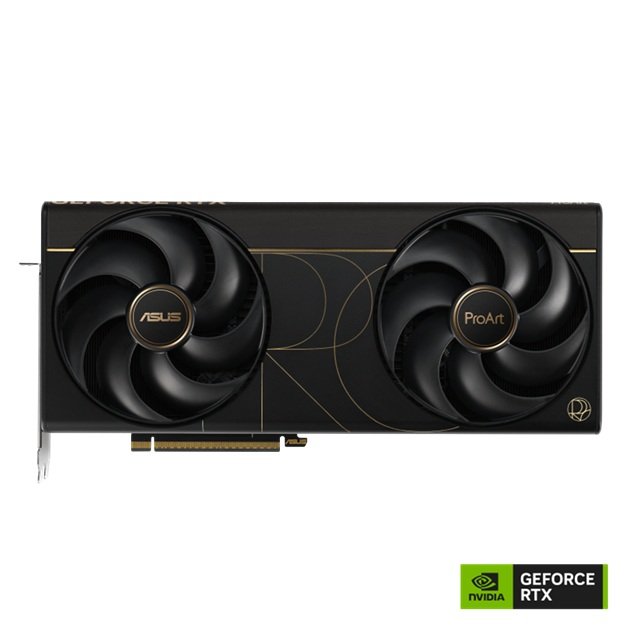
Cooling closely mirrors Nvidia’s Founders Edition philosophy. Asus ProArt GeForce RTX 5090 uses a vapor chamber, multiple heat pipes, and two large 115 mm axial fans that push air through a dual-flow backplate. Asus also applies liquid metal between the GPU die and the heatsink a premium and technically demanding solution that improves heat transfer and allows the card to maintain high performance without growing to triple-fan proportions.
A Rare Sight: A Headphone Jack on a GPU
One of the most surprising design choices is the inclusion of a 2.5 mm headphone jack, something virtually unheard of on modern graphics cards. The audio output sits alongside the DisplayPort and HDMI connectors, as well as a USB-C port designed for displays and peripherals.
The USB-C connection replaces one of the traditional DisplayPort outputs and is clearly aimed at creators who use portable monitors, docking setups, or daisy-chained displays.
Minimalist ProArt Aesthetic
Visually, the RTX 5090 ProArt embraces a clean, industrial look. There’s no RGB lighting, no decorative elements, and no unnecessary embellishments. This marks a clear departure from the previous ProArt RTX 5080, which featured faux-wood accents and even an onboard M.2 SSD slot.
Those features are completely gone on the RTX 5090 a change that will likely be welcomed by professionals who value reliability, cooling, and performance over stylistic experimentation.
Pricing and Availability
Asus has not yet announced official pricing or availability. For reference, the ProArt RTX 5080 launched at $1,469, nearly $500 more than standard RTX 5080 models. Given the RTX 5090’s flagship status, creator-focused features, compact design, and advanced cooling solution, it’s reasonable to expect an even higher price point when it reaches the market.
Overall, the ProArt GeForce RTX 5090 feels less like a showpiece and more like a serious workstation tool unconventional headphone jack included.